Mosaics with Cast Stone and Ceramic
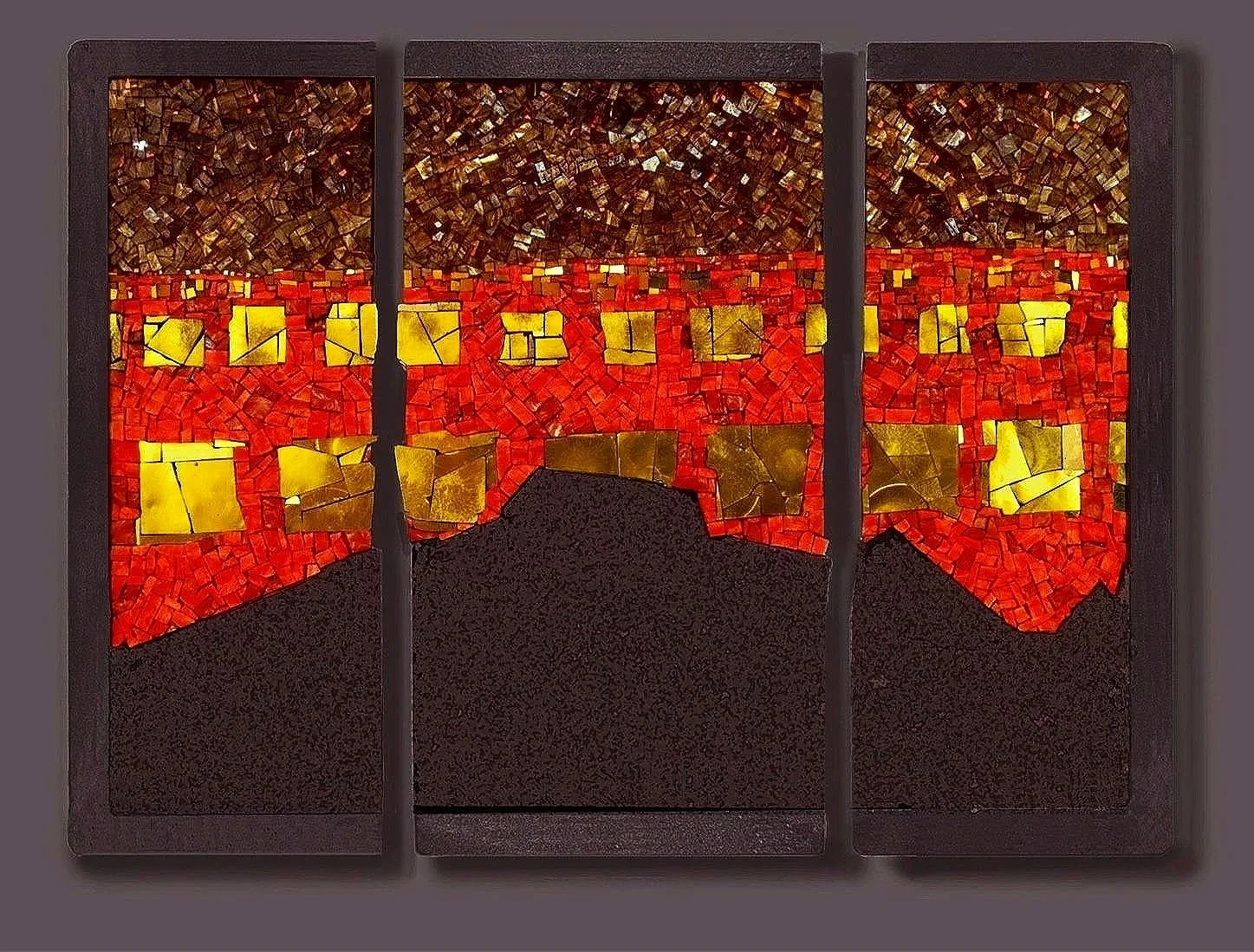
6th Circle. Cast stone relief and hand cut Venetian glass mosaic
Carter, a mosaic artist, mixes media to add visual context and physical support to his mosaic creations. With a background in architectural ceramic sculpture, Carter incorporates ceramic and cast stone into his mosaic compositions. In an effort to reduce the weight of his mosaic compositions and maintain a visual relationship to the mosaics' original surroundings, an Italian masonry context in the United States, with few interior masonry walls, Carter invented a cast stone support and frame for his mosaics.

When Carter began making the mosaic, a friend lent him Dante's book "The Inferno." "Three days after finishing the mosaic, he read the chapter, The Sixth Circle. He was surprised and puzzled when he first looked at the mosaic he had just created. The artist saw in the mosaic the same scene described by Dante in his Inferno: "From the charred heights of the entrance of Dis, the Capitoline Hill of Hell, he saw the tombs of incandescent heretics scattered across a landscape of molten lava, beneath a blazing sky with burning stars. The only explanation for the coincidence is that when the artist lived in Ravenna he passed by Dante's tomb almost every day.
Carter visits Mauseleum of Dante Alighieri.Ravenna, Italy 2024.
When Carter lived in Ravenna he walked past Dante’s Tomb everyday.


6th Circle. Artist’s residence.
The Prophetic Resonance of Carter's "6th Circle": A Bridge Between Modern Art and Dante's Ravenna
In Jerry Carter's "6th Circle," we encounter a remarkable phenomenon of artistic synchronicity that bridges contemporary mosaic art with Dante's medieval vision. The work's creation process - completed before Carter had read the corresponding Canto - suggests what Carl Jung might have termed a manifestation of the collective unconscious, where ancient literary imagery emerges spontaneously through modern artistic expression.
The psychic significance of the work operates on multiple levels. First, there is the uncanny parallel between Carter's artistic vision and Dante's text, discovered only after the work's completion. This synchronicity suggests a deep psychological connection between artistic creation and literary memory, perhaps influenced by Carter's years of walking past Dante's tomb in Ravenna and his absorption of the city's rich cultural heritage. The artist's unconscious mind appears to have channeled Dante's imagery of the City of Dis before consciously encountering it in text.
The mosaic's composition itself speaks to psychological depths: the stark contrast between the dark upper realm and the glowing golden tombs set against red-hot plains creates a tension between darkness and illumination that mirrors the human psyche's struggle between knowledge and ignorance, faith and heresy. The use of Murano smalti - a material deeply connected to Italian artistic tradition - adds another layer of unconscious connection to the work's geographical and cultural context.
For Ravenna's historical narrative, Carter's "6th Circle" represents a compelling continuation of the city's mosaic tradition. Ravenna, home to some of the world's most significant Byzantine mosaics, has long been a center of mosaic art. Carter's work, created after his time in Ravenna, demonstrates how the city continues to inspire contemporary artists, maintaining its role as a crucible for mosaic innovation. The fact that Carter unknowingly created a vision so aligned with Dante's text - in a city where Dante spent his final years and remains buried - suggests a kind of artistic osmosis, where the city's rich cultural heritage unconsciously influences modern creators.
The work also serves as a bridge between Ravenna's two major cultural legacies: its Byzantine mosaic tradition and its connection to Dante. By combining modern mosaic techniques with Dantean imagery, Carter's work represents a contemporary synthesis of these historical threads. The piece's installation above a fireplace adds another layer of meaning, as the hearth's flames echo the burning plain of the Sixth Circle, creating a domestic portal that mirrors Dante's literary gateway to the underworld.
The unintentional nature of the work's connection to Dante's text makes it particularly significant for Ravenna's cultural history. It suggests that the city's artistic and literary heritage continues to resonate through time, influencing contemporary artists even before they consciously engage with its historical sources. This phenomenon reinforces Ravenna's ongoing relevance as a living center of artistic and literary inspiration, rather than merely a repository of historical artifacts.
Carter's broader body of work, focusing on life's precarious existence within Earth's atmosphere, adds another dimension to the piece's significance. When viewed in this context, the "6th Circle" becomes not just a reflection of Dante's inferno, but a commentary on contemporary environmental concerns, suggesting that modern humanity might be creating its own infernal landscape through environmental degradation.
In conclusion, the psychic and historical significance of Carter's "6th Circle" lies in its demonstration of how artistic creation can unconsciously channel historical and literary traditions, particularly in a place as culturally rich as Ravenna. The work serves as both a continuation of Ravenna's mosaic tradition and a bridge to its Dantean heritage, while simultaneously speaking to contemporary environmental concerns. Its creation story suggests that the cultural memory of places like Ravenna continues to influence artistic creation in ways that transcend conscious intention, creating new connections between past and present.
Original Sketch for an un-named composition that became The 6th Circle.
Red Spacescape


Red Spacescape. Venetian glass mosaic, cast stone and car enamel. Seen with the official military model of VOSTOK I, Yuri Gagarin's first manned flying satellite. Red Spacescape depicts human trash and clutter against the dim light of planet Earth.
“Red Space Scape” is a striking artwork that blends cast stone relief, Venetian glass mosaic, and car enamel. It reflects Carter’s cosmic vision, harmonizing powerful cosmic forces with human remains. Vibrant energy flows gracefully, symbolizing galactic vitality, while debris orbiting near a distant planet reminds us of our small presence. The work captures the grandeur of space and human insignificance, evoking awe and introspection. It is a testament to the artist’s skill, inviting contemplation of the universe and our place within it.”
Blue Space Scape - Cast Relief Multiple with Venetian glass mosaic.

STELE II
Carter created Stele II, dedicated to the living planet Earth. She was inspired by the Roman tombstones of St. Appolonaire en Classe. They were significant because they served not only as a marker for the deceased, but also as a means of commemorating his life. These upright stone slabs often included an inscription with the deceased's name, lineage, and achievements, making them an important source of historical information.


United Technologies Optical Division. Jupiter, Florida. USA
ANCIENT ATMOSPHERE

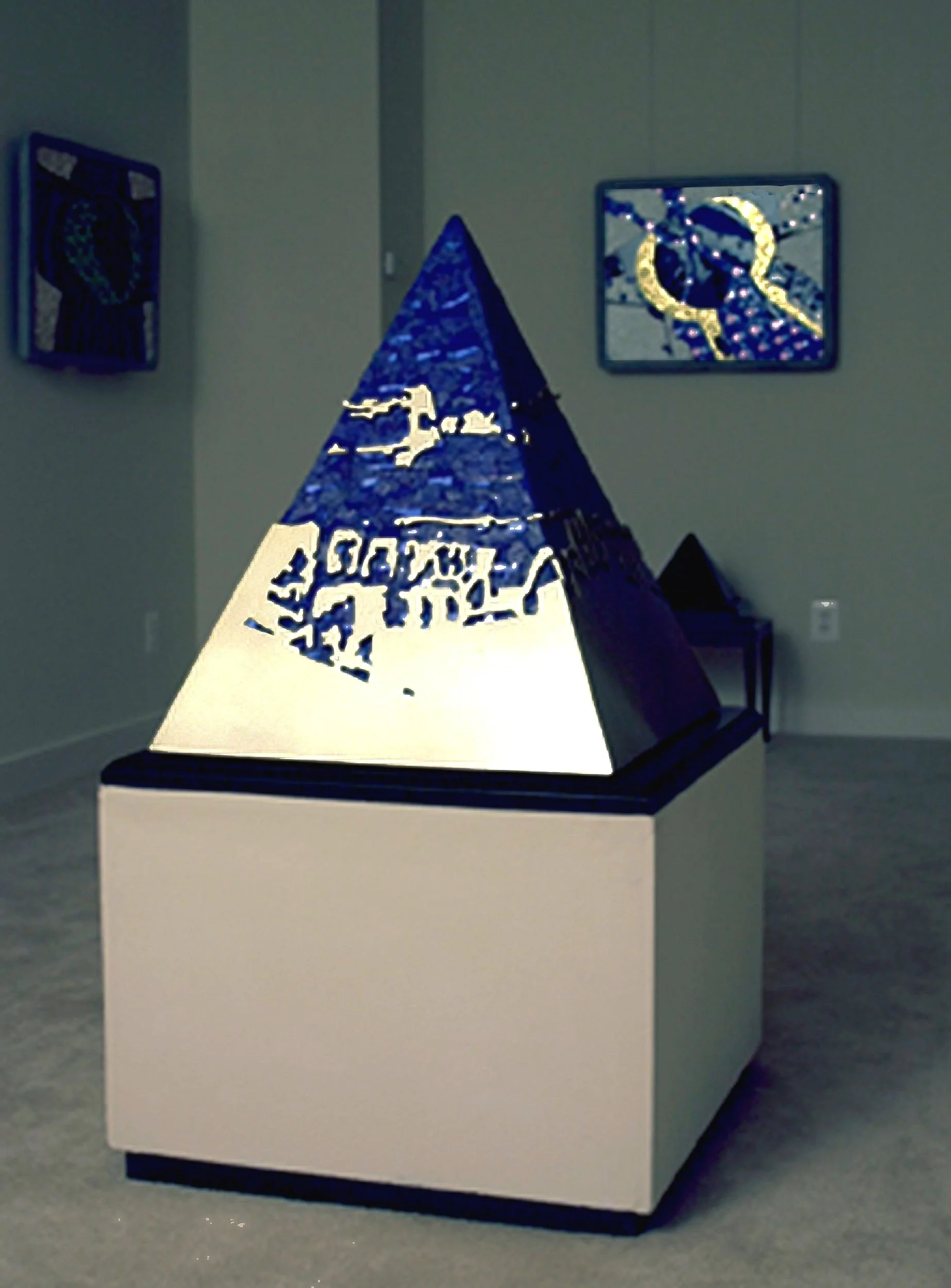
ANCIENT ATMOSPHERE. Mosaic, cast stone and automotive enamel. Captures the clean planetary air of pre-industrial era.
Ancient Atmospheres exhibited: American Association for the Advancement of Science. Washington, D.C. Galleria MARC, Moscow Artists Association Gallery, Spaso House Gallery, Galleria M’souri Georgian Cultural Center, Galleria Esplanade, Helsinki. America Hause. Cologne and Munich, Germany.

“[Carter] uses glass mosaic techniques to create freestanding sculptures, such as his highly impressive blue-gold pyramid…. With this extraordinary combination of classical techniques and modern sculptural design, J. W. Carter has filled a singular niche within today’s art scene.”
• Cologne Art Review, Köln, Germany
LIFE-DISC SERIES
FAILED ATMOSPHERE

Failed Atmosphere. Life Disc Series. Exhibited at American Association for the Advancement of Science National Headquarters. Second North American Conference on Sealevel Rise, The Environmental Defense Fund. -Washington, D.C. 1988.


GREEN LIFE DISC
HOMAGE TO THE LIVING PLANET
Green Life Disc won the Lorenzo di Medic Award at the International Biennial of Contemporary Art in Florence, Green Life Disc was also exhibited at the Arcetri Astrophysical Observatory, dominated by Galileo's residence, and inaugurated on Leonardo da Vinci's birthday.

Homage to GAIA is the focal point of the artist’s dining room. Standing on either side in placements reserved for saints, Artist Carter places two hand carved statues. Instead of traditional saints, Carter presents his saints: The Farmer and The Farm Wife.

COPPER LIFE DISC I

COPPER LIFE DISC II
The Observer
The Observer di Jerry Carter è un'opera d'arte visivamente accattivante creata utilizzando una combinazione di materiali: pietra fusa, smalto per auto, smalti in vetro veneziano e. L'uso del mosaico in vetro veneziano aggiunge una qualità vibrante e luminosa all'opera. Il contrasto tra smalto liscio e vetro veneziano diviso aggiunge una composizione visivamente sorprendente.

La figura centrale dell'opera è raffigurata in piedi in mezzo alla vegetazione verde. È raffigurato mentre disegna, il che suggerisce che sia un osservatore o un artista che cattura la scena intorno a lui. Questa rappresentazione ricorda Vincent van Gogh, in particolare il suo dipinto Ingresso al giardino pubblico di Arles, dove è in piedi a leggere un giornale circondato da alberi giganteschi e nodosi..

Pegasus


"Jerry Carter's "PEGASUS" combines Venetian glass mosaic and cast stone relief, embellished with automotive enamel, creating a timeless yet contemporary masterpiece. This artwork embodies Carter's dedication to the well-being of the Earth, depicting Pegasus, the mythical winged horse, a symbol of unity and preservation. With boundless creative freedom, Pegasus soars towards eternal life, representing a collective effort for the prosperity of all beings. Carter's piece is a triumphant tribute to the beauty and interconnectedness of nature.
Lapland

Lappland.
Ceramic relief glass mosaic. Diameter 1.8 m. Exhibited in Carter's MFA exhibition at Antioch University Columbia Visual Arts Center, Columbia Maryland. The National Wildlife Federation Headquarters. Alexandria, Virginia. The Royal Embassy of Norway, Washington, D.C.
Lappland as exhibited in Brookside Gardens Arboretum Montgomery County Maryland,


CASCADE

Cascade, ceramic relief, hand cut Venetian glass mosaic, and stained and opainted concrete column, rises 38 feet [12 meters high] from the floor of the Vista International Hotel in Washington, D.C.
Carter prepared, sculpted, fired, glazed and installed more than 2700 lbs of sculpture clay and 600 lbs of Murano smalti into Cascade.


“Aesthetics of the 20th Century” “Humanism and concern for the future of our planet characterize the creations of American artist Jerry Carter…. [He] crystallizes the concept that we live on a fragile planet…. The unrepeatable uniqueness of his composition “Cascade” …is achieved through the contrast of concrete, glass and metal…[and] symbolizes the future of humanity.” • Ecco Planet, TASS Magazine, Moscow, Russia..
Above: Photo of Cascade. Back Cover of Echo Planet.

Jerry W. Carter artist, Giuseppe Checci, President, International Development Inc. and Star Wars set architect, Wayne Williams.

BEAR LAKE
KARHU JARVI [Bear Lake] Ceramic, marble and gold Venetian glass. 1M X 1M

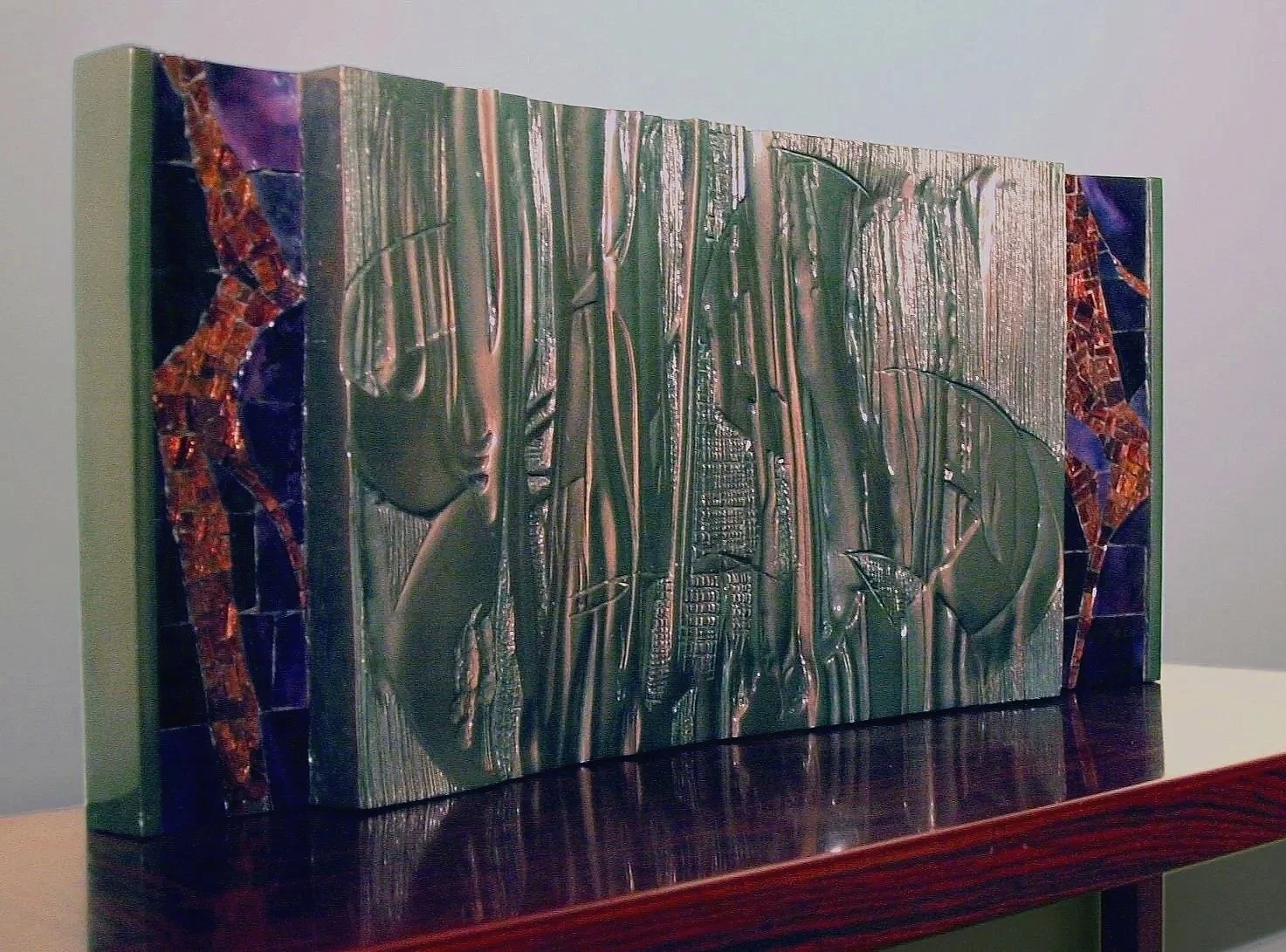
INTERIORS. By Jerry W. Carter
A high cast stone relief in meta flake automotive enamel, and Venetian Glass mosaic.
INTERIORS

Scandinavian Autumn Nights

Scandinavian Autumn Nights, by Jerry W. Carter, made of cast stone and Venetian Glass, captures long Autumn sunsets over the Gulf of Finland.