Carter asks us to consider a difficult idea: that the ultimate entity — what many call “god” — is a living presence spread across the thin crust of this molten planet. It includes the atmosphere, the planet’s life-support systems, and all living matter in its waters, its air, and the surfaces and crevices of its rock.
His work invites us to see how the elements of nature are connected, and how each of our actions affects the whole living system of the planet. We hold a privileged place on Earth, and with it a responsibility to protect what sustains us second by second. Our finite minds cannot grasp its full magnificence, but through the Mysterion of the Cosmos, Carter asks us to contemplate it.
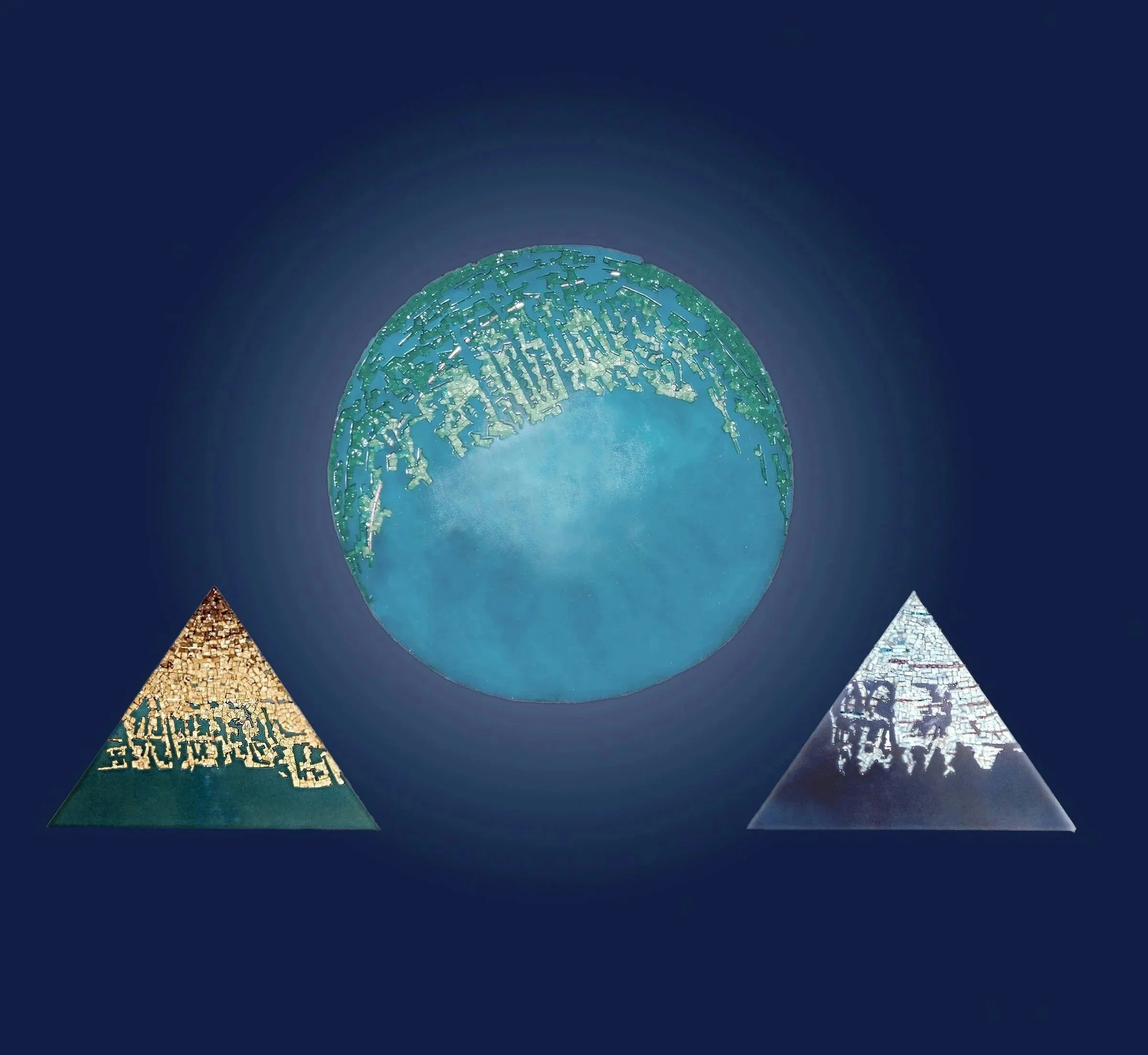
MYSTERION OF THE COSMOS
I
II
Two Exhibitions of the Mysterion of The Cosmos in Florence Italy at:
Florence International Biennale of Contemporary Art, 2003
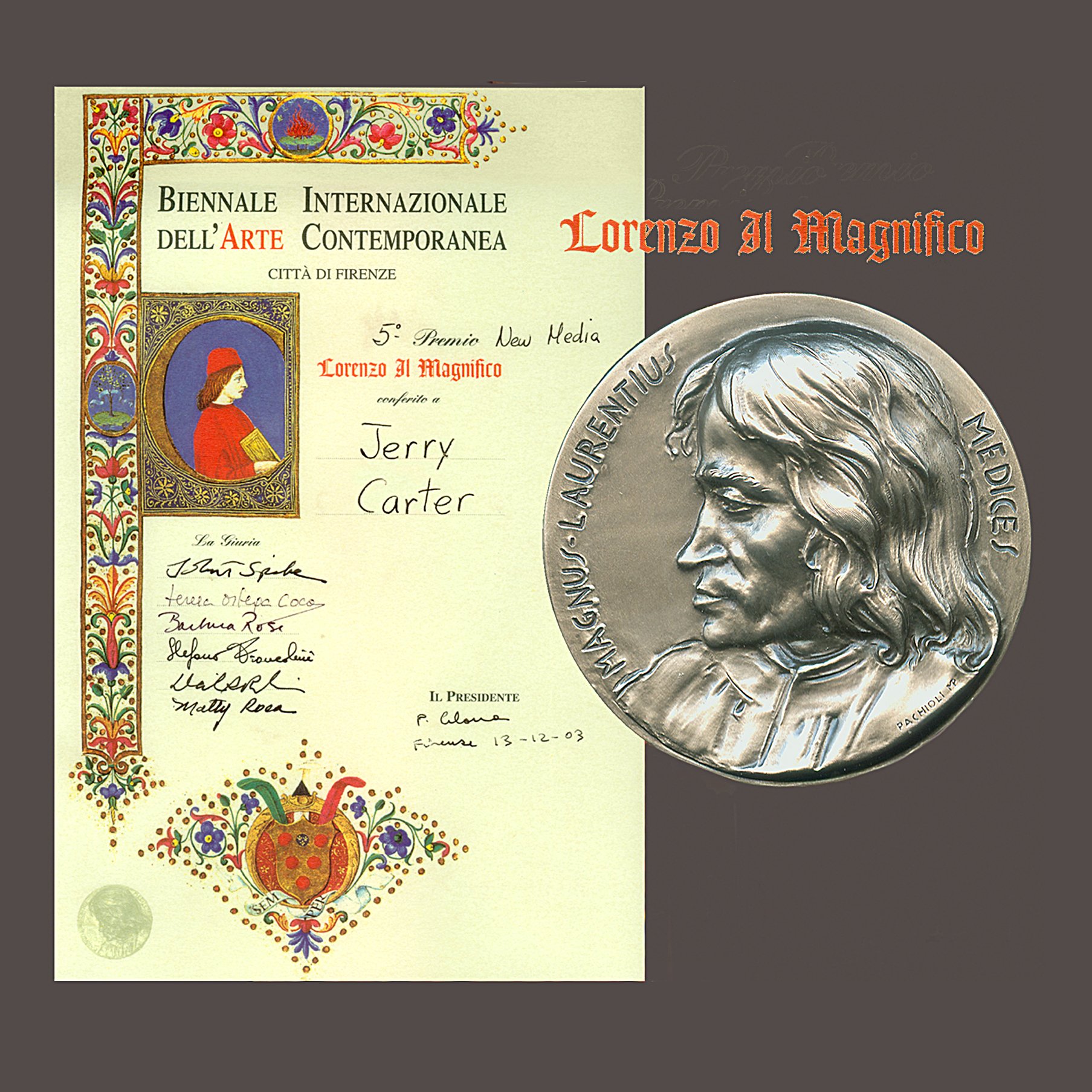
(Winner of the Lorenzo il Magnifico Award, 2003)
Arcetri Observatory, Florence
(The first work of art exhibited at the Arcetri Astrophysical Observatory, beneath Galileo’s final residence. Opened on Leonardo da Vinci’s birthday, April 15, 2004.)

I
Mysterion of the Cosmos at the Florence International Biennale of Contemporary Art, 2003

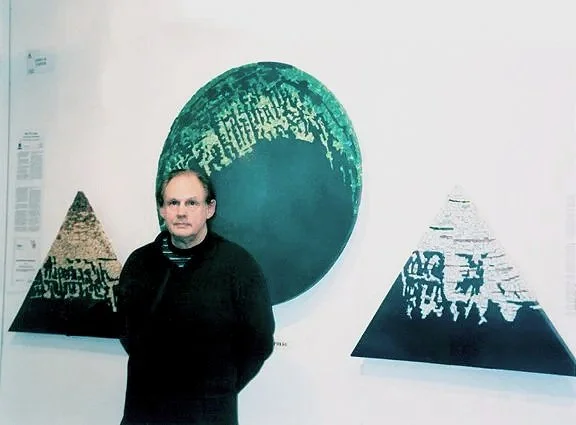
At the Biennale, the Mysterion of the Cosmos received the Lorenzo il Magnifico Award. The award came in the “New Media” category — an irony, since mosaic is one of the oldest pictorial art forms. What made it new was the combination: Venetian glass mosaic with cast stone and automotive enamel.

Artist’s Statement
The Green Life Disc Concept
The Green Life Disc is the central symbol of Carter’s GAIA series. Just as a CD stores data on its surface, Earth stores the blueprints of all life in its thin atmosphere and rocky crust — not in two dimensions, but in many. The disc stands for human consciousness and all terrestrial life within Earth’s interconnected support systems.
The concept first appeared in Carter’s solo exhibition at the national headquarters of the American Association for the Advancement of Science, where Green Life Disc and its companion piece, 6th Circle, were the centerpieces.
Technique and Influences
Carter’s cast stone reliefs draw on three traditions: mosaic, which he studied and practiced in Ravenna, Italy’s mosaic capital; architectural ceramics; and American hot-rod enamel painting.
He applies automotive enamels in the manner of the 16th-century Venetian colorists Titian and Tintoretto. He begins with an earth-red ground, adds a white-blended middle layer for depth, then builds transparent layers of color embedded with crystalline flakes. A final transparent blue layer catches and reflects light, and a protective glaze seals the surface.
The Three Works
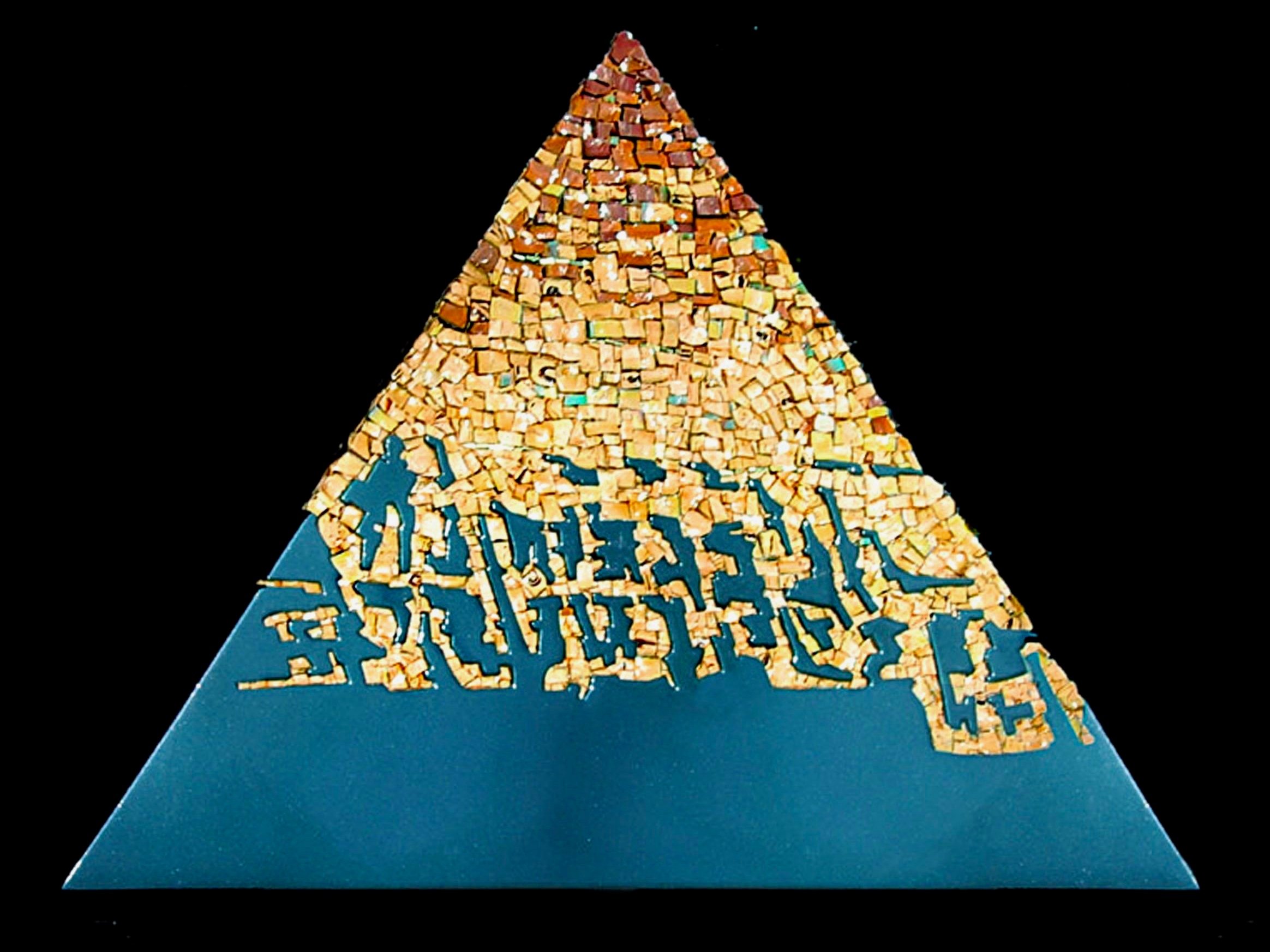
Together, the three reliefs form a single pictogram of visible and invisible meaning. The geometric space between them is part of the composition — a “non-present object,” in the manner of certain Renaissance artists. Their shared subject is the future of life on Earth and humanity’s part in that future.
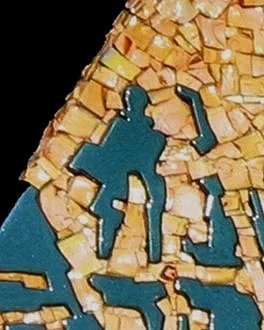
Observer — 90 × 60 × 4 cm. Triangular composition in Venetian glass mosaic, cast stone and automotive enamel. The observer — artist and scientist — takes notes amid green vegetation; the tessellated background is Earth’s warm atmosphere.
Green Life Disc (Image of Gaia) — 100 cm diameter. The disc is the repository of the genetic code for all life on Earth. As it degrades, that code is lost. The observer looks through the planet’s atmosphere as it thins and disappears.

Pegasus — 90 × 60 × 4 cm. Triangular composition. It represents the nobility possible to the inspired, imaginative human soul in union with the forces of Gaia.


Critical Response
John T. Spike, Ph.D.
John T. Spike, Ph.D. (Harvard), art historian and Artistic Director of the Florence International Biennale of Contemporary Art — Florence, 2003
Spike: “This artist has been officially recognized by NASA for the connection between his art and — would you say astronomy, or science?”
Carter: “For the scientific understanding of climate and location — the scheme of things in space.”
“As I approached the wall, not knowing the work, I could tell that the artist was fascinated by science — and there is a long and wonderful tradition of that, especially in Florence. During the Renaissance, artists’ desire to represent the world more realistically was central to their scientific thinking; imagining the world was a way of exploring it scientifically.
This artist is doing the same thing. He could have been a physicist or an astronomer, but he uses the metaphor of art to address these problems — and that was evident even as I approached. He has organized his exhibition as a scientific demonstration, and in a scientific demonstration, the more data the better, as long as it is not confused. It is not. It is very clear.
Your works successfully express your intense personal involvement with what you’re doing. They are not random. They are put together in such a way that we consider their importance to you. …
Yours is a language you invented to express your very true observations about the ecological disaster that is taking place. We need people to be concerned like you; otherwise we will be fiddling atop our own burning pyre.”
Excerpts edited lightly for clarity from Dr. Spike’s spoken remarks, recorded in the video above.
In 1984, NASA’s Goddard Space Flight Center recognized Carter’s work for its connection to science.
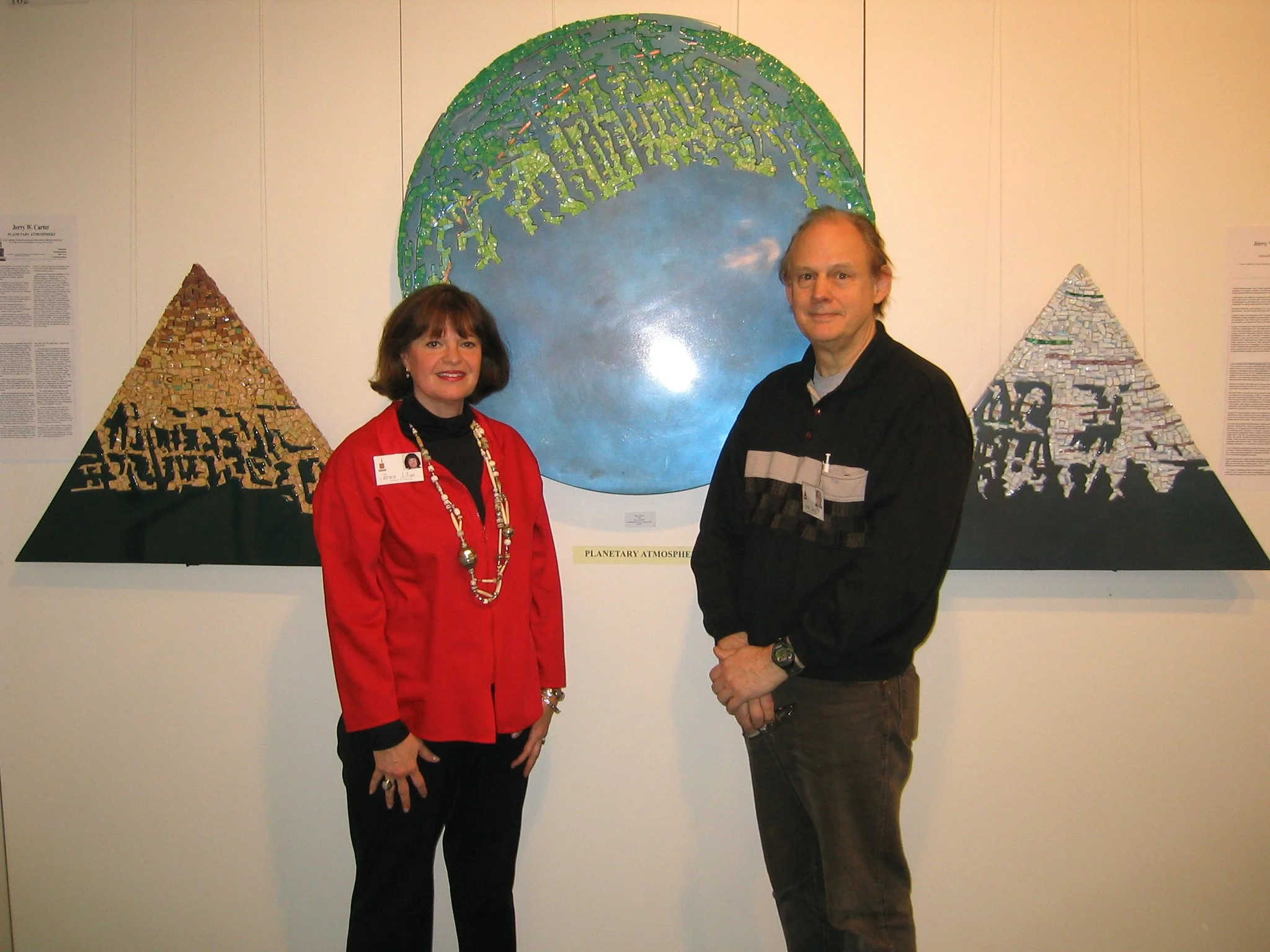
Carter with fellow mosaic artist Lillian Broca, also exhibiting at the Biennale.
Exhibition at the Arcetri Astrophysical Observatory, Florence — April 15 – May 28, 2004
II


The Mysterion of the Cosmos was the first work of art exhibited at the Arcetri Astrophysical Observatory, on the hill below the villa where Galileo Galilei spent his final years. The exhibition opened on April 15, 2004 — Leonardo da Vinci’s birthday.
It was opened by Dr. Marco Salvati, Director of the Observatory, and organized with Dr. John T. Spike, art historian and Artistic Director of the Florence Biennale; Dr. Vito Abba, the Biennale’s director of public relations; and Dr. Maurizio Seracini (seracini.com), the scientist known for his technical analysis of Leonardo’s Adoration of the Magi.
The installation brought together four works — Objects of the Mysterion, Green Life Disc, Observer and Pegasus — and presented art in dialogue with astronomy, at the place where Galileo redefined Earth’s position in the universe.
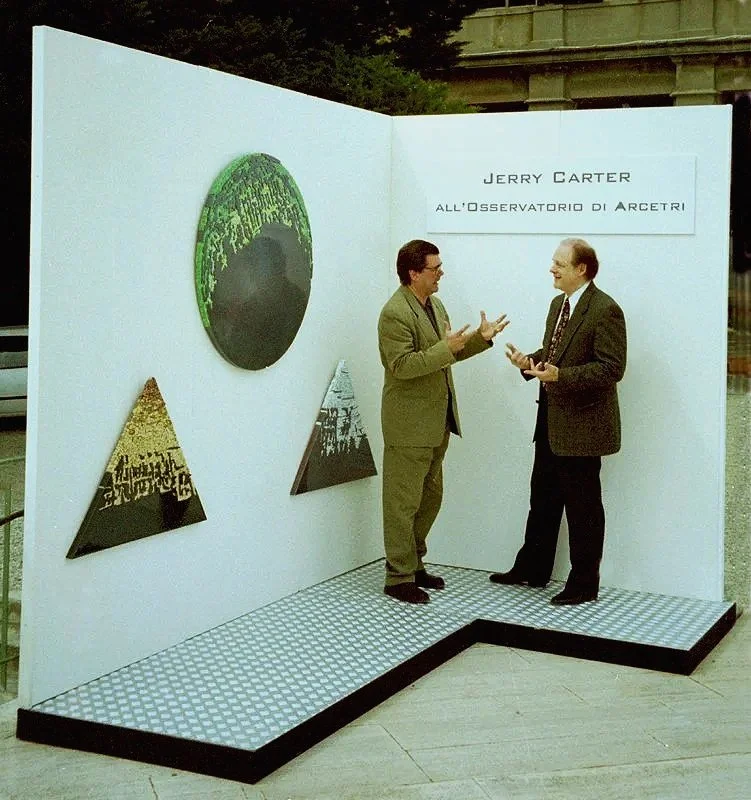
Art historian Dr. John T. Spike and Jerry Carter at the Arcetri exhibition.
Art Meets Science and Philosophy
This work represents Carter’s effort to understand the cosmos by uniting art, science and philosophy, and our planet’s place in the universe. He believes that 21st-century humanity can achieve extraordinary things when we work together, and the work is offered in that collaborative spirit.
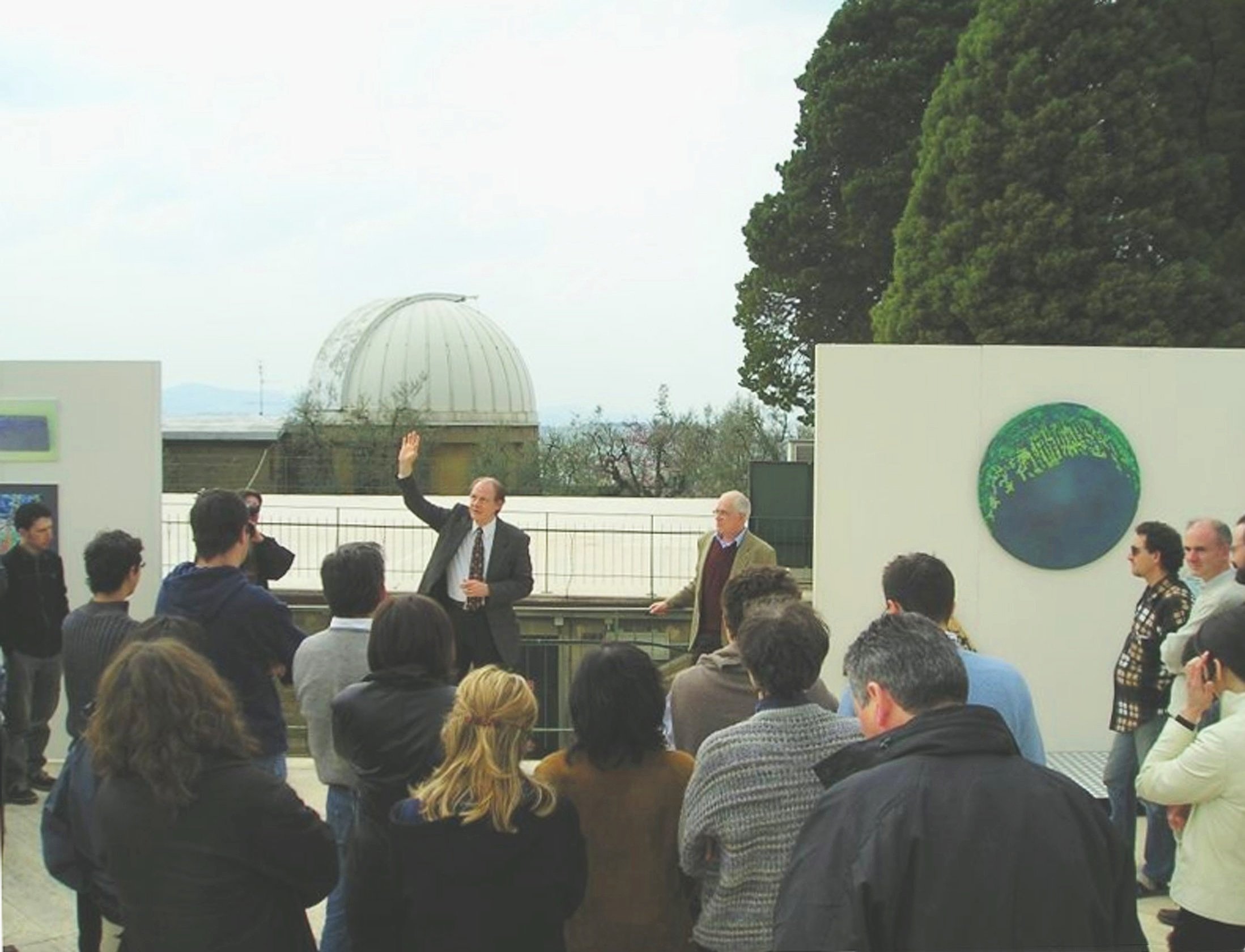
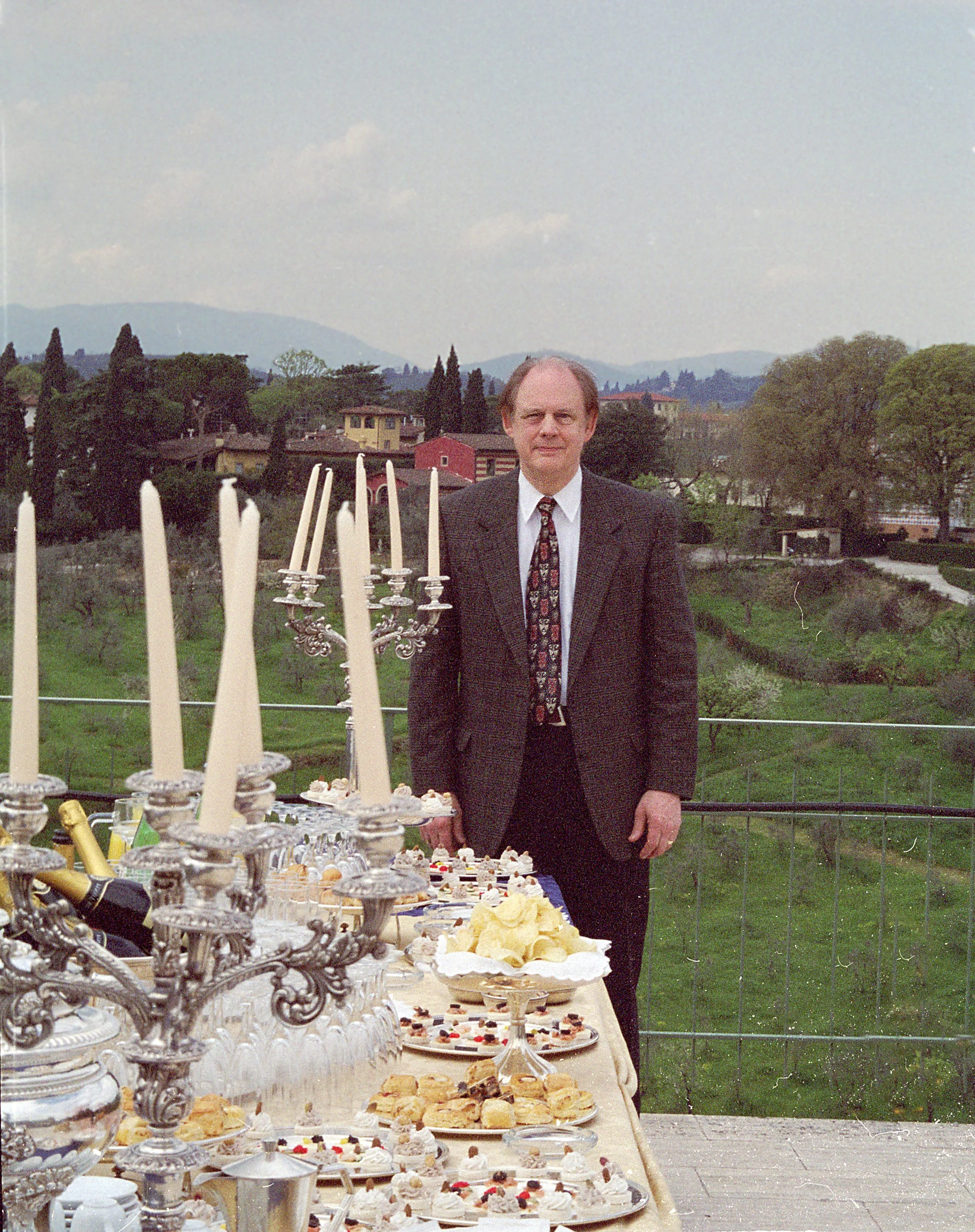
Carter explains the Mysterion of the Cosmos to scientists at the Arcetri Observatory, Florence.

Galileo’s residence stands on the hill in the background.
Il Mysterion del Cosmo — exhibition catalogue, 20 pages
In English and Italian, with texts by art historian Dr. John T. Spike; Dr. Daniel Y. Gezari, infrared astronomer at NASA Goddard Space Flight Center; and the artist.

Exploring Universal Mysteries
"Mysterion of the Cosmos" attempts to capture the profound mysteries of existence—the enigmatic, ineffable, and elusive aspects of our universe. At its heart, the piece expresses humanity's fundamental desire to understand the cosmos and find our place within it.
Using sculpture, painting, and mosaic techniques, Carter conveys the awe and wonder we experience when contemplating the universe's vastness and complexity. The artwork serves as both a spiritual meditation and a celebration of cosmic beauty.
Jerry Carter with Dr. Marco Salvati, Director of the Arcetri Astrophysical Observatory, Florence.
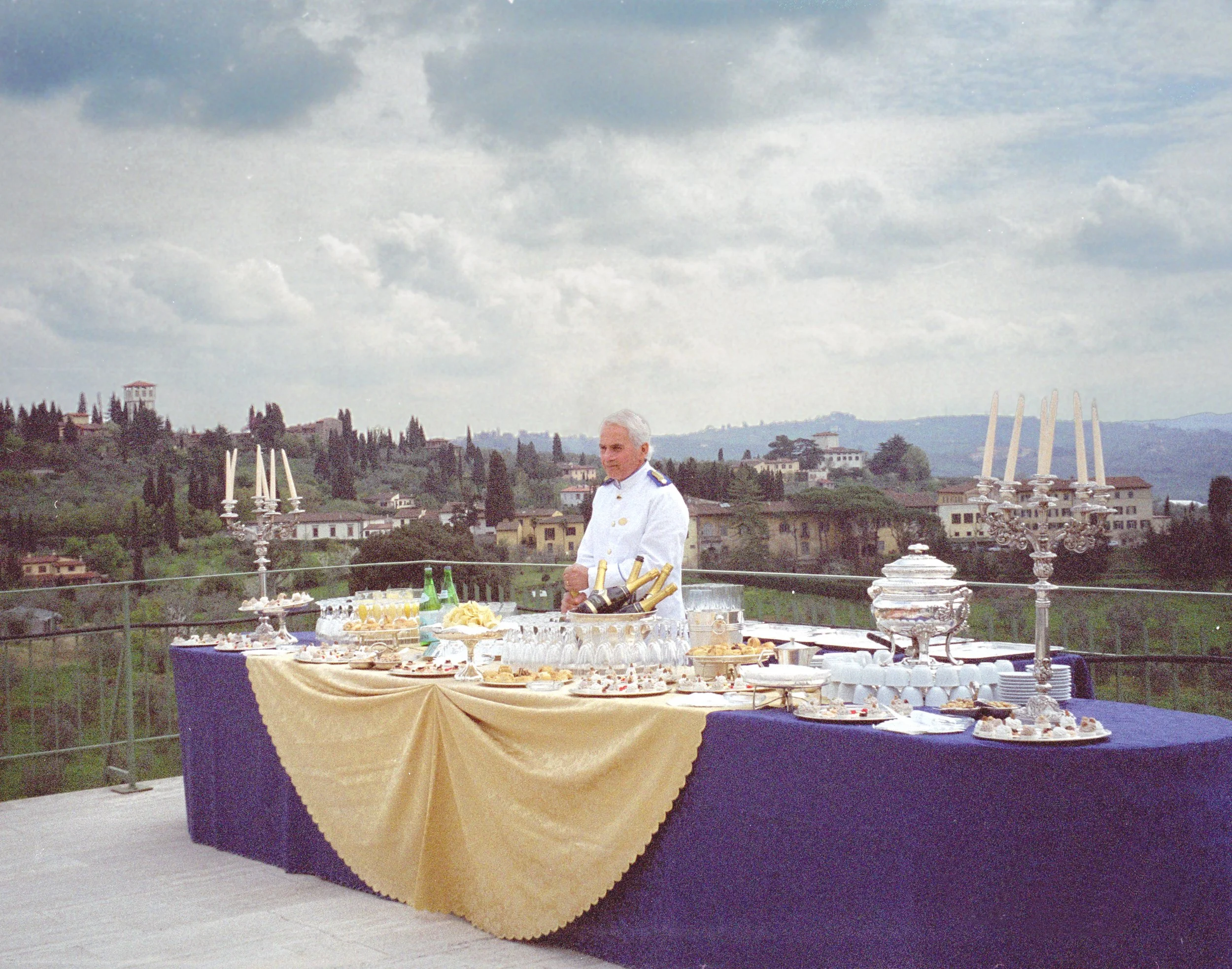
Reception at the Arcetri Observatory
A Spiritual and Visual Journey
The work reflects Carter’s belief that a divine presence infuses the cosmos — both transcendent and intimately near. It invites viewers to contemplate the mysteries of existence and their connection with the universe.
It expresses the human condition itself: our drive for knowledge, our need to connect with something greater, and our delight in the beauty of the universe.
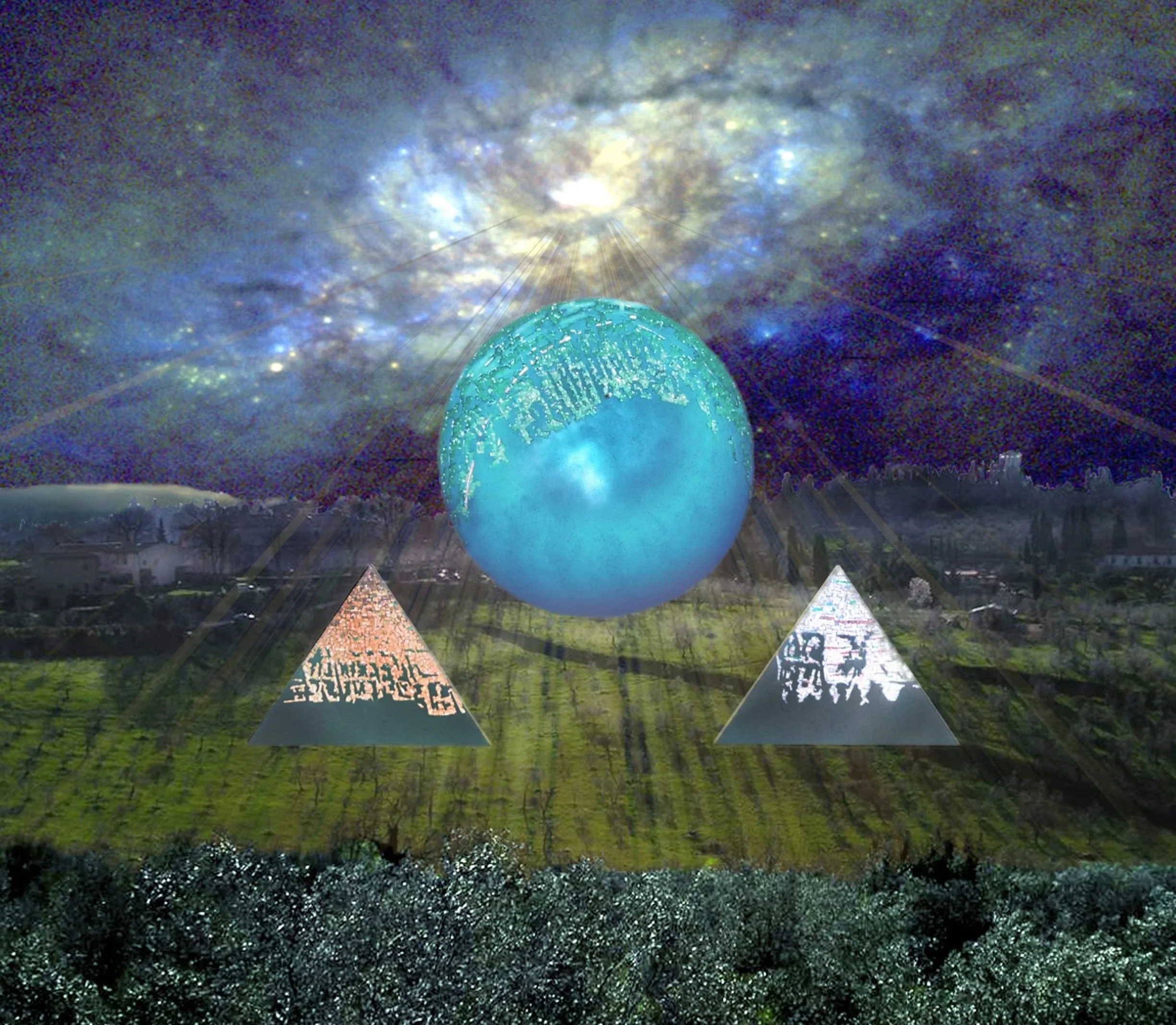
The Arcetri Connection
The lower portion grounds this cosmic vision in a specific place: rolling Tuscan hills and vineyard patterns mark the landscape where Galileo spent his final years contemplating these same mysteries. Radiating light beams connect sky to earth, suggesting the continuous flow of cosmic influence on terrestrial existence.
Technical Mastery
Carter’s layered transparency technique runs throughout. Light seems to come from within the disc and radiate outward through the cosmic backdrop, joining the Venetian colorist tradition with automotive enamel painting.
The painting joins scientific observation with spiritual contemplation — much as Galileo did from his residence at Arcetri, seen in the background.
Mysterion of the Cosmos at Arcetri. Jerry W. Carter. Acrylic on canvas, 1.4 × 1.4 m.
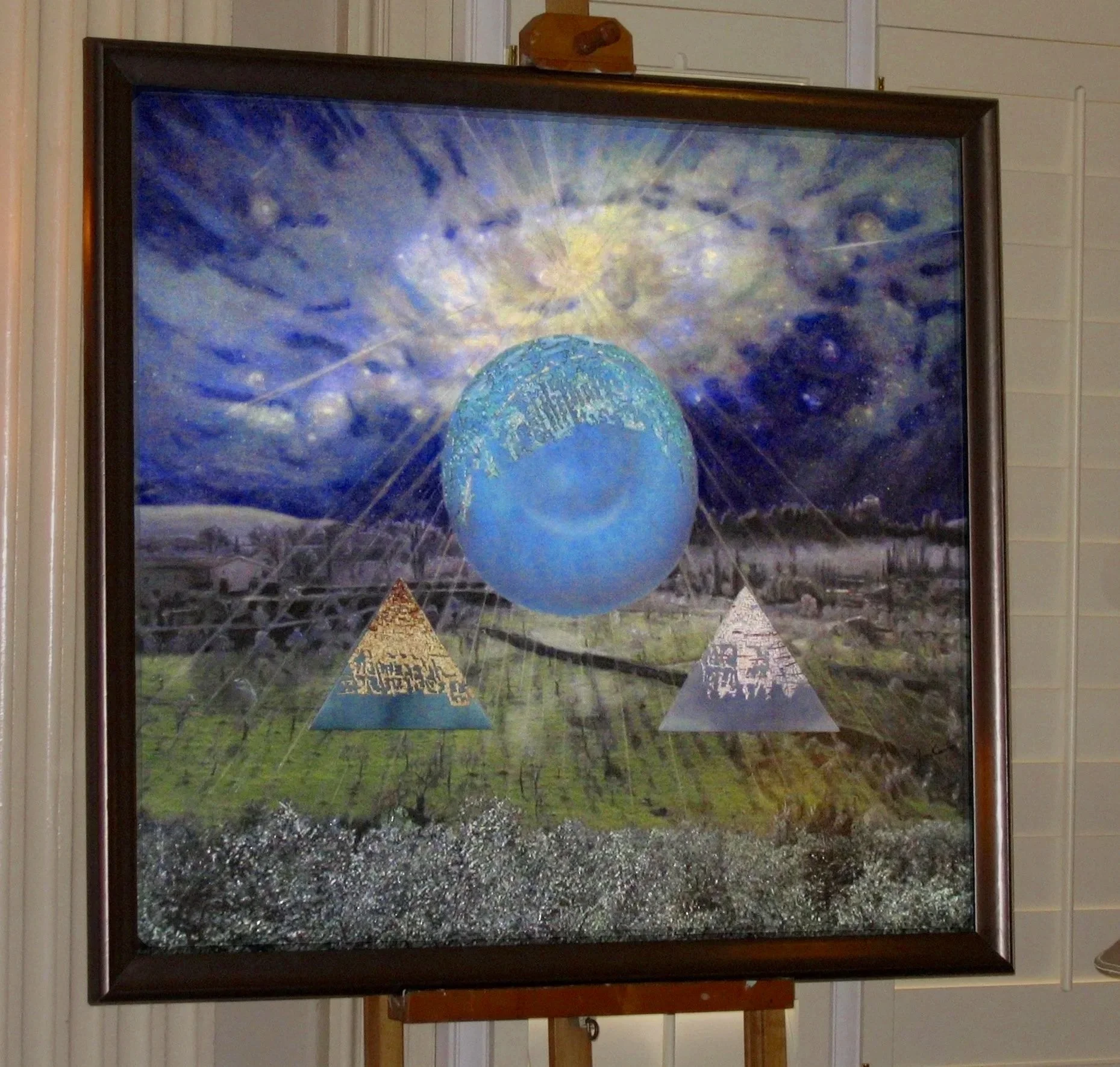
Visual Elements and Symbolism
The central blue-green disc glows with ethereal quality, suggesting both Earth's biosphere and a cosmic data storage device. Set against swirling nebular patterns, it evokes the CD/information storage metaphor at the heart of Carter's Green Life Disc concept.
Two triangular forms flank the disc, adding geometric stability to the cosmic chaos. One appears textured and earthbound, the other ethereal and cosmic - representing the dual nature of human understanding as they frame Earth's story within the larger universe.